Showing posts with label twin to twin transfusion. Show all posts

Tuesday, December 7, 2010

TTTS Awareness: What you need to know

Comments
World TTTS Awareness Day

December is TTTS (Twin-to-Twin Transfusion Syndrome) Awareness month, and today is World TTTS Awareness Day. TTTS is a disease of the placenta that can affect identical twins who share one placenta. The babies themselves are healthy, the issue is with the placenta and the circulation of blood between the babies and the placenta. (More about TTTS at the bottom of the post). I have shared our experience with TTTS with our boys previously. For today I want to focus on what you can do to help, and what you need to know if you or someone you know is pregnant.

An ultrasound is encouraged within the first three months to determine whether there are multiples, and if so, whether there is a shared placenta. TTTS only occurs in identical twins with a shared, monochorionic placenta. Monochorionic means one placenta and one outer sac, and there can be either one or two inner (amniotic) sacs. Twin pregnancies can be any of the following:

Dichorionic / diamniotic (two placentas, two amniotic sacs)
Monochorionic / diamniotic (one placenta, two amniotic sacs)
Monochorionic / monoamniotic (one placenta, one amniotic sac)

Once it is determined that there is only one placenta, extra precautions can be taken to monitor the pregnancy and watch for any potential issues.

From the TTTS Foundation website, here are the 15 most important questions for parents expecting twins to get answers to (the link has a more detailed explanation for each question):

Confirm at First Ultrasound (preferably by 10-16 weeks)

1. Is the placenta monochorionic?
2. Are the babies the same sex?
3. Can you see the dividing membrane?
4. Is the placenta anterior or posterior?
5. Do the cords have 3 vessels or 2?
6. Are the cords fully attached to the placenta?

Ask at Weekly Ultrasounds (Starting at Week 16 to Delivery)

7. What is the largest vertical pocket of fluid for each baby?
8. Can you see the bladder of the donor baby?
9. What are the weights of the babies in grams? (every 2-3 weeks)
10. Are the dopplers normal for both babies?
11. Is the heart of the recipient baby enlarged or thickened?
12. Does the recipient baby have hydrops?
13. What is the measurement of your cervix, is it long and
closed or thinning or dilated?
14. Is the smaller baby growing at the same rate?
15. What is the fundal height?

And for those who may not be familiar with TTTS, here is an overview, also from the TTTS Foundation website:
What is TTTS?
-Twin to Twin Transfusion Syndrome (TTTS) is a disease of the placenta (or afterbirth) that affects identical twin pregnancies.

-TTTS affects identical twins (or higher multiple gestations) who share a common monochorionic placenta.

-The shared placenta contains abnormal blood vessels which connect the umbilical cord and circulations of the twins.

-The common placenta may also be shared unequally by the twins

-The events in pregnancy that lead to TTTS are all random.

-TTTS is not hereditary or genetic, nor caused by anything the parents did or did not do.

-TTTS can happen to anyone.

And from the Fetal Hope Foundation website:
TTTS or Twin-to-Twin Transfusion Syndrome is a disease of the placenta. It affects pregnancies with monochorionic (shared placenta) multiples when blood passes disproportionately from one baby to the other through connecting blood vessels within their shared placenta. One baby, the recipient twin, gets too much blood overloading his or her cardiovascular system, and may die from heart failure. The other baby, the donor twin or stuck twin, does not get enough blood and may die from severe anemia. Left untreated, mortality rates near 100%.

The cause of TTTS is attributed to unbalanced flow of blood through vascular channels that connect the circulatory systems of each twin via the common placenta. The shunting of blood through the vascular communications leads to a net flow of blood from one twin (the donor) to the other twin (the recipient). The donor twin develops oligohydramnios (low amniotic fluid) and poor fetal growth, while the recipient twin develops polyhydramnios (excess amniotic fluid), heart failure, and hydrops. If left untreated, the pregnancy may be lost due to lack of blood getting to the smaller twin, fluid overload and heart failure in the larger twin, and/or preterm (early) labor leading to miscarriage of the entire pregnancy.

Some general treatment approaches consist of using laser energy to seal off the blood vessels that shunt blood between the fetuses. Because the surgical approach is via an operative fetoscope, there is minimal risk to the mother. Laser therapy for TTTS has been shown to provide improved pregnancy outcomes compared to alternative therapies. Although all treatment options should be discussed with your fetal surgeon.


TTTS Resources
:
TTTS Foundation
TTTS resource @ Twinstuff - written by a father of twins who survived TTTS
Fetal Hope Foundation
Club Deb Radio Interview - TTTS
World TTTS Awareness Day
Matthew and Steven TTTS Walk for the Babies


Reposted from last year with minor edits


If you enjoyed this post, get free updates by email or RSS.
Read More >>

Sunday, December 6, 2009

TTTS Awareness: What you need to know

Comments

December is TTTS (Twin-to-Twin Transfusion Syndrome) Awareness month, and tomorrow is World TTTS Awareness Day. TTTS is a disease of the placenta that can affect identical twins who share one placenta. The babies themselves are healthy, the issue is with the placenta and the circulation of blood between the babies and the placenta. (More about TTTS at the bottom of the post). I have shared our experience with TTTS with our boys previously. For today I want to focus on what you can do to help.

Judy Bogdan of Club Deb interviewed Mary Slaman-Forsythe, Founder and President of the Twin to Twin Transfusion Syndrome Foundation. Judy emailed me and asked if I would share her interview here to help get the word out, and I am honored to do so. Her family has been touched by TTTS as well, in a heartbreaking way, as her niece lost one of her twins due to this condition.

You can listen to the interview here. It's very informative, but also very personal as Mary Slaman-Forsythe shares her own experience and how the TTTS Foundation came to be started. One of the things I really liked was suggestions on how to help inform moms who may be pregnant with multiples. As Judy mentioned, it's hard to know how to bring up TTTS for fear of scaring a pregnant mom, but Mary suggested a way to share the information in a non-threatening way by simply asking them if there is one placenta or two. That way, it will hopefully get them to follow up with their doctor to find out if they don't already know, and that is one of the most important questions to answer in assessing risk for TTTS.

Why is that so important? TTTS only occurs in identical twins with a shared, monochorionic placenta. Monochorionic means one placenta and one outer sac, and there can be either one or two inner (amniotic) sacs. Twin pregnancies can be any of the following:

Dichorionic / diamniotic (two placentas, two amniotic sacs)
Monochorionic / diamniotic (one placenta, two amniotic sacs)
Monochorionic / monoamniotic (one placenta, one amniotic sac)

Once it is determined that there is only one placenta, extra precautions can be taken to monitor the pregnancy and watch for any potential issues.

From the TTTS Foundation website, here are the 15 most important questions for parents expecting twins to get answers to:

Confirm at First Ultrasound (Hopefully by 12 Weeks)

1. Is the placenta monochorionic?
2. Are the babies the same sex?
3. Can you see the dividing membrane?
4. Is the placenta anterior or posterior?
5. Do the cords have 3 vessels or 2?
6. Are the cords fully attached to the placenta?

Ask at Weekly Ultrasounds (Starting at Week 16 to Delivery)

7. What is the largest vertical pocket of fluid for each baby?
8. Can you see the bladder of the donor baby?
9. What are the weights of the babies in grams? (every 2-3 weeks)
10. Are the dopplers normal for both babies?
11. Is the heart of the recipient baby enlarged or thickened?
12. Does the recipient baby have hydrops?
13. What is the measurement of your cervix, is it long and
closed or thinning or dilated?
14. Is the smaller baby growing at the same rate?
15. What is the fundal height?

And for those who may not be familiar with TTTS, here is an overview, also from the TTTS Foundation website:
What is TTTS?
-Twin to Twin Transfusion Syndrome (TTTS) is a disease of the placenta (or afterbirth) that affects identical twin pregnancies.

-TTTS affects identical twins (or higher multiple gestations) who share a common monochorionic placenta.

-The shared placenta contains abnormal blood vessels which connect the umbilical cord and circulations of the twins.

-The common placenta may also be shared unequally by the twins

-The events in pregnancy that lead to TTTS are all random.

-TTTS is not hereditary or genetic, nor caused by anything the parents did or did not do.

-TTTS can happen to anyone.

And from the Fetal Hope Foundation website:
TTTS or Twin-to-Twin Transfusion Syndrome is a disease of the placenta. It affects pregnancies with monochorionic (shared placenta) multiples when blood passes disproportionately from one baby to the other through connecting blood vessels within their shared placenta. One baby, the recipient twin, gets too much blood overloading his or her cardiovascular system, and may die from heart failure. The other baby, the donor twin or stuck twin, does not get enough blood and may die from severe anemia. Left untreated, mortality rates near 100%.

The cause of TTTS is attributed to unbalanced flow of blood through vascular channels that connect the circulatory systems of each twin via the common placenta. The shunting of blood through the vascular communications leads to a net flow of blood from one twin (the donor) to the other twin (the recipient). The donor twin develops oligohydramnios (low amniotic fluid) and poor fetal growth, while the recipient twin develops polyhydramnios (excess amniotic fluid), heart failure, and hydrops. If left untreated, the pregnancy may be lost due to lack of blood getting to the smaller twin, fluid overload and heart failure in the larger twin, and/or preterm (early) labor leading to miscarriage of the entire pregnancy.

Some general treatment approaches consist of using laser energy to seal off the blood vessels that shunt blood between the fetuses. Because the surgical approach is via an operative fetoscope, there is minimal risk to the mother. Laser therapy for TTTS has been shown to provide improved pregnancy outcomes compared to alternative therapies. Although all treatment options should be discussed with your fetal surgeon.


TTTS Resources
:
TTTS Foundation
TTTS resource @ Twinstuff - written by a father of twins who survived TTTS
Fetal Hope Foundation
Club Deb Radio Interview - TTTS
World TTTS Awareness Day
Matthew and Steven TTTS Walk for the Babies


If you enjoyed this post, get free updates by email or RSS.
Read More >>

Sunday, December 7, 2008

Dec 7th is World TTTS Awareness day

6 comments

Today is World TTTS (Twin to Twin Transfusion Syndrome) Awareness day, and December is TTTS Awareness month. If you've been reading my blog for a while, you may recall that our twins, Cuddlebug and Bearhug, are TTTS survivors. From what I have read, diagnosis and treatment has improved considerably since I was pregnant with our twins 8 years ago. Still, awareness is crucial to helping women who are pregnant with multiples get the information they need and for their doctors to be on the lookout for possible signs of TTTS. It is a life-threatening condition so the earlier it can be detected and treatment options evaluated, the better.

What is Twin to Twin Transfusion Syndrome?

TTTS is a disease of the placenta that affects identical twins who share a placenta. It occurs when the shared placenta contains abnormal blood vessels connecting the two babies, and results in one baby (the "recipient") receiving too much blood / nutrients, while the other baby (the "donor") receives too little. Cuddlebug was our "donor" twin and Bearhug was our "recipient," which is why Bearhug was red and bigger at birth, with his heart struggling to pump because his blood was thick like syrup. Cuddlebug was pale, smaller, and anemic, with his body struggling to make its own red blood cells to make up for the shortage. Our boys were not diagnosed with TTTS until delivery, which thankfully was early because I had developed pre-eclampsia. Despite the complications of prematurity, their early delivery saved their lives, because it's unlikely they could have survived much longer in the womb.

A little primer on twinning

In order to better understand how TTTS happens, it helps to understand how twins develop. Fraternal (dizygotic) twins occur when two eggs are fertilized by two sperm. Fraternal twins have two sacs and two placentas.

Identical (monozygotic) twins occur when a single egg is fertilized by a single sperm, and then during early cell division, the embryo splits an extra time to create two genetically identical embryos. If the split occurs before day 4, the twins will have separate sacs and placentas, just like fraternal twins. If the split occurs between days 4 - 8, the twins will share an outer sac and a placenta, but will have separate inner sacs (monochorionic/diamniotic). That was the case with our boys. If the split occurs between days 8 - 12, they will share both an inner and outer sac (monochorionic/monoamniotic) and a placenta. A split occurring after day 12 generally results in conjoined twins.

I heard it explained once as the later the split, the more "connected" the twins will be, and essentially babies are at risk for TTTS when they are "connected" at the placenta.

If you are pregnant

TTTS can happen to anyone. It is essential to have an ultrasound within the first 3 months of pregnancy to determine whether you are carrying multiples and if so, whether they share a placenta and inner/outer sac. That way, extra monitoring can be started early if you are carrying multiples who are at risk for TTTS.

If you are carrying multiples who are at risk, it's important to know that there is hope! Even with a shared placenta, there may not necessarily be uneven distribution of blood and nutrients. Monitoring is critical to help catch any potential problems as early as possible. If signs begin to appear that there may be a problem, there are treatment options available that have been successful for many babies.

For more information

World TTTS Awareness Day
TTTS Foundation
Fetal Hope Foundation
TTTS Awareness Day - News Release
TTTS Foundation - Fact Sheet


If you enjoyed this post, get free updates by email or RSS.
Read More >>

Saturday, August 30, 2008

Finding Courage through Sharing - Aug 2008

7 comments
CMCblogcarnival

The topic for this month is memories and memory markers. Share about something that trips a memory in your journey with your child or children, or just a memory that is special to you. The memory can be happy, sad, or anything in between. If you don’t have time to write specifically for this prompt, feel free to share a post that matters to you from your archives. I’m looking forward to seeing what you have to share this month…

Michelle's post about her family's NICU experience got me thinking about our NICU experience. Our twins were born prematurely and were diagnosed with Twin-to-Twin Transfusion Syndrome. I wrote a series of posts about our experience a couple of months ago. Since the topic for today is memories, here is a glimpse of the experience in pictures.

This is a card that the NICU nurses made for me the morning after the boys were born (they were born at night). It meant so much to me that they took the time to do this, I am crying just thinking about it. I spent most of that day alone in my hospital room, as dh was in the NICU with the boys (where he should be!). I was unable to get out of bed for 24 hrs, so I couldn't visit them in the NICU. These are the only pictures we have of them from that first day.

Here is a chart the nurses put up on Cuddlebug's crib, I'm not sure why they didn't do one for Bearhug. I loved how it described him as a person, with his likes and dislikes. I enjoyed doing Kangaroo care with both of the boys when they were stable enough for it.


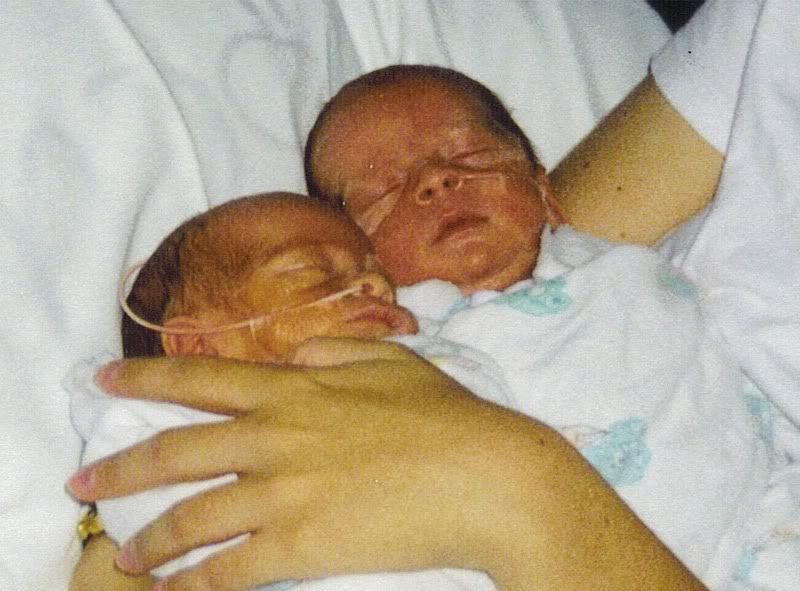
We didn't really start taking pictures until they were 9 days old. By that point, Bearhug was off of the CPAP and Cuddlebug was out of the isolette, they were able to co-bed, and we were able to hold them both. Here is our first family picture, along with each of us holding them. They were still attached to monitors and had feeding tubes, so we had a lot of "equipment" around but at least we could hold them :).


They spent their first Father's Day in the NICU, so the nurses made these cards for dh with their little handprints / footprints. Aren't they cute?


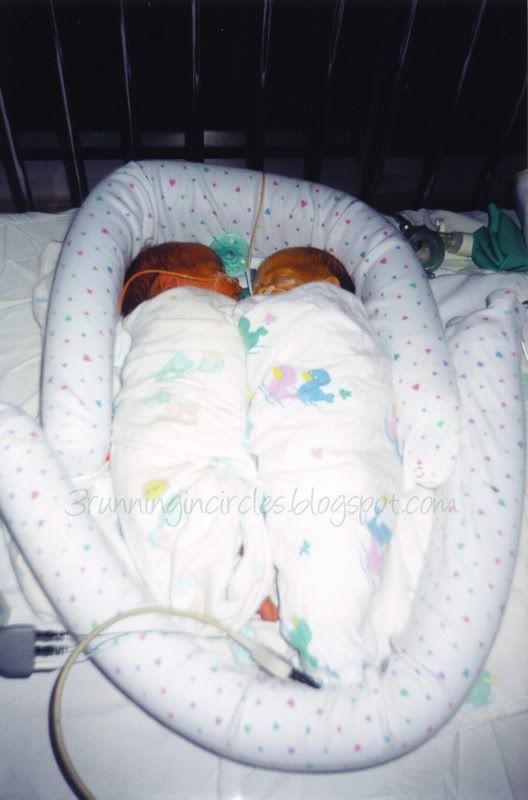
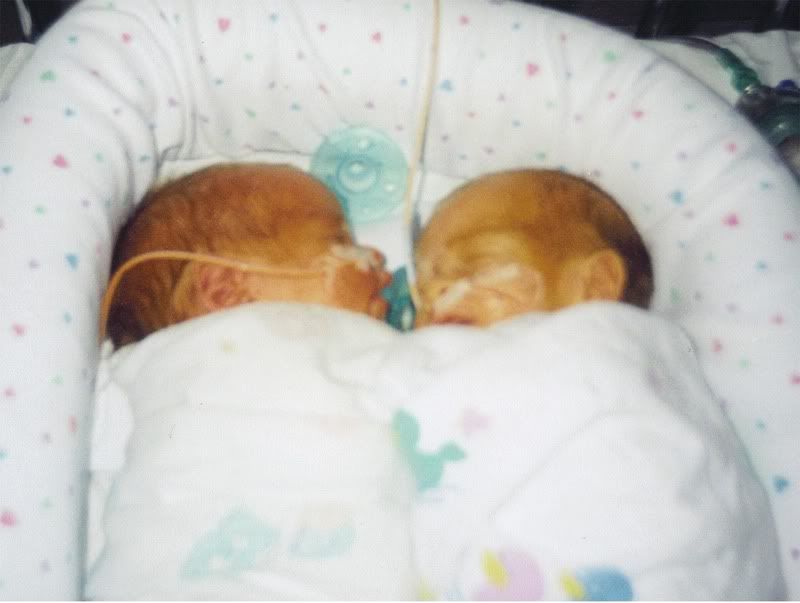
Here are a few more picture of the boys. The little orange tubes are their feeding tubes. They used to like to work their arms out of their blankies and pull out each other's feeding tubes, talk about teamwork LOL. I like how in this one, you can see Bearhug's little toes sticking out from his blankie :).

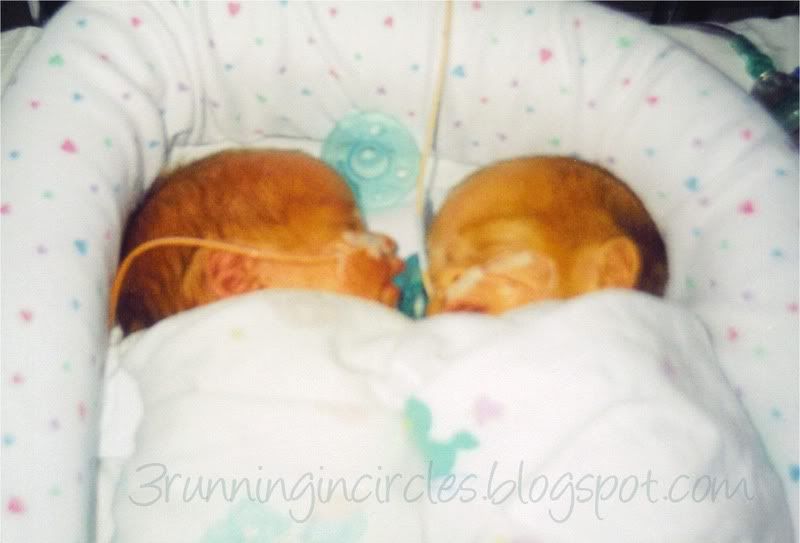
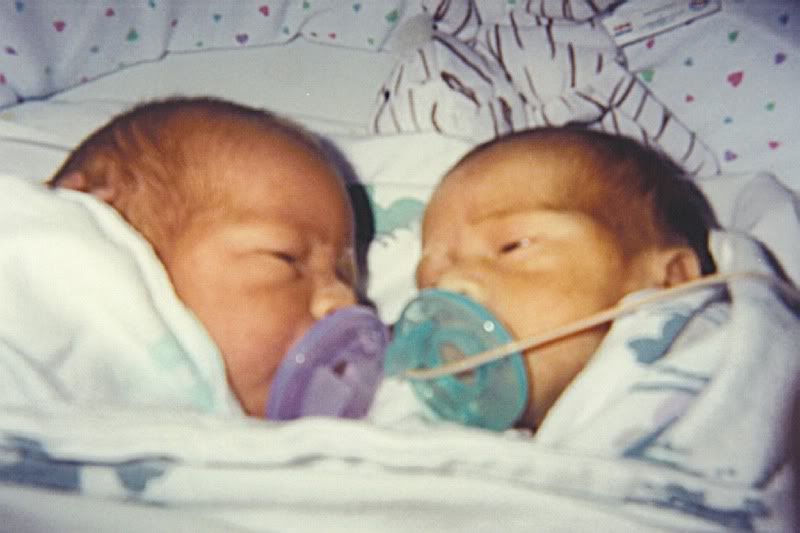
A close-up of their precious little faces. That's Bearhug on the left and Cuddlebug on the right.


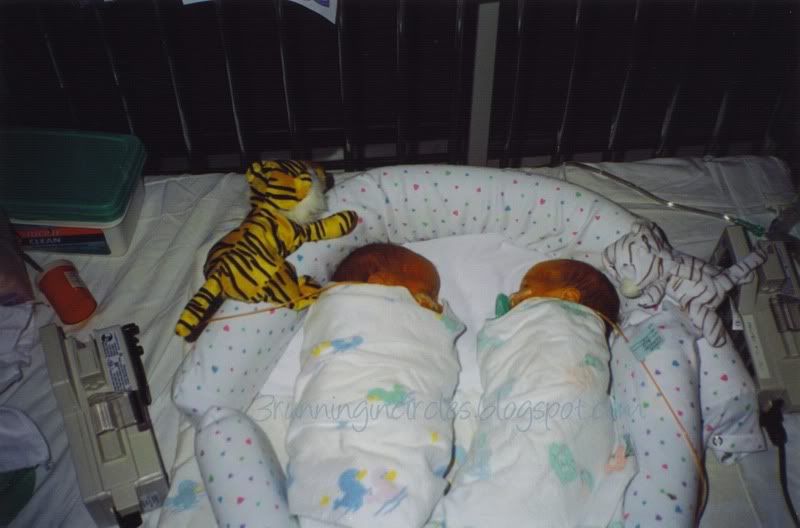
Here you can see the little stuffed tigers we got to keep them company in the crib :). Those are appx beanie baby size, so that gives some perspective on how little the boys were.


These are the things I thought about when the boys have gone through their some of their more difficult times. Whenever I started to feel overwhelmed with trying to help our boys overcome the challenges that are part of autism, I thought about how they came into the world. Given the survival odds for babies with TTTS at the time, the fact that they are with us is nothing short of a miracle. Two miracles :). (And 3 1/2 yrs later - a third miracle!) When I thought of that, my feelings of despair would quickly turn to gratitude, and I felt immeasurably blessed to even have the chance to go through these challenges with my boys, because we very nearly did not have that opportunity.


TTTS is a disease of the placenta that affects identical twins with a shared placenta, in which abnormal blood vessels connecting the two babies develop in the placenta. When this happens, blood flows out of one baby and into the other, which if left untreated is life-threatening for both twins. In our case, the boys weren't diagnosed until delivery. They were born with >25% size difference, with Cuddlebug weighing 4 lbs 1 oz (he was the "donor twin") and Bearhug weighing 5 lbs 8 oz (he was the "recipient twin"). (back to top)

Read More >>

Sunday, June 15, 2008

Seven years ago today... (part 6)

Comments
For the month of June, I decided to write a series of posts about my twins' first month of life to help raise awareness about prematurity and TTTS (twin-to-twin transfusion syndrome).

Seven years ago today, Bearhug and Cuddlebug were finally able to co-bed in the same crib together in the NICU. They seemed much happier to finally be together again. They both still had their feeding tubes in... sometimes they'd get their arms out of their swaddled blankies and pull each other's feeding tubes out. Talk about working together :).


To be continued...

To learn more about TTTS, see http://www.tttsfoundation.org/
For more info on prematurity, see http://www.marchofdimes.com/

Read More >>

Friday, June 13, 2008

Seven years ago today... (part 5)

Comments

For the month of June, I decided to write a series of posts about my twins' first month of life to help raise awareness about prematurity and TTTS (twin-to-twin transfusion syndrome).

Seven years ago today, after 8 long days of waiting for him to be stable enough, I was finally able to hold my Bearhug for the first time! He was so precious and I was so happy to be able to finally cuddle with him. He had some issues with his heart that we were watching, at that point the dr's didn't know if he'd need surgery or if it would resolve on its own (thankfully, resolved on its own but he had to be seen for follow-ups by a cardiologist periodically for the first 9 mos to be sure everything was ok).

Now that both babies were able to be held, I even held them together sometimes, with the help of the nurses. What a joy! After 7 1/2 mos pg w/ my precious babies it had been so hard to lose that closeness after they were born, it probably sounds weird but I finally felt "whole" again when the three of us could cuddle together.

The boys were both still under phototherapy lights for much of the time due to jaundice. At some point (don't remember the exact day) they had been taken off the IV's and given feeding tubes (through their noses into their stomachs). They weren't able to nurse yet so I was still attempting to pump. I had milk supply issues (that's a looong story for another post) but they got all the milk I was able to get - it was given to them through their feeding tubes along w/ special preemie formula.

At this point I had been discharged from the hospital, so I was going to the hospital every morning to visit the boys, I spent my days there until dh got off work and came to visit them with me and then take me home. I'd gone home when they were 4 days old. It was hard leaving the hospital without our babies, and seeing other new moms taking their babies home, and it was hard going home to two empty cribs. I especially got annoyed with people who told me to rest while I could, because I didn't want to rest, I wanted my babies to be home waking me up all night! Not to mention I wasn't getting rest anyway, I was waking up to an alarm every 3 hours so I could pump. But, I knew my babies were where they needed to be for the time being...

To be continued...

Read More >>

Saturday, June 7, 2008

Seven years ago today... (part 4)

Comments
For the month of June, I decided to write a series of posts about my twins' first month of life to help raise awareness about prematurity and TTTS (twin-to-twin transfusion syndrome).

Seven years ago today, I made my way to the NICU again to visit my babies, who were 2 days old. I asked when I'd be able to hold them, and they said I could go ahead and hold Cuddlebug for a few minutes. I cried, I was so happy. The nurse helped me gently lift him out of the isolette, and showed me how to keep the monitor wires from getting tangled up or pulling off. I only got to hold him for a few minutes that first time, but I loved finally getting to cuddle with him!

Bearhug was able to "graduate" from the respirator to a c-pap. He wasn't stable enough to be held yet, so I spent some time sitting with him and letting him hold my finger.

To be continued...

To learn more about TTTS, see www.tttsfoundation.org
For more info on prematurity, see www.marchofdimes.com
Read More >>

Friday, June 6, 2008

Seven years ago today... (part 3)

Comments

For the month of June, I decided to write a series of posts about my twins' first month of life to help raise awareness about prematurity and TTTS (twin-to-twin transfusion syndrome).

Seven years ago today, I woke up in the morning alone in my room. Dh spent most of his the day in the NICU with the boys. A nurse brought me a card with some polaroid pics of the boys. Because of the meds they had me on (due to pre-eclampsia) I had to stay in bed for 24 hrs after delivery, so I couldn't go see them yet. Finally, late that night, I was wheeled down to the NICU to see my babies for the first time since delivery.

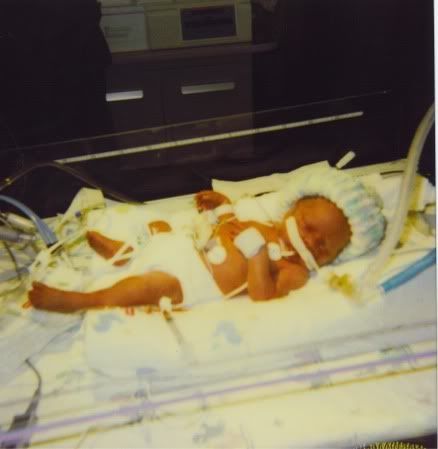
They were beautiful, but they looked so small and fragile. It was hard to see them hooked up to so many machines and monitors. They both had respiratory distress. Bearhug was on a respirator at first; Cuddlebug could breathe but needed a small tube of oxygen underneath his nose. He was in an isolette. They were both under phototherapy lights due to jaundice (with the little shades that look like sunglasses). They were both on IV's, and at that point neither of them were stable enough to be held, which was really heartbreaking. I was able to hold BH's hand (really it was letting him hold my finger, his hands were so small) , and they let me open the little door in CB's isolette for a minute so I could do the same with him.

I left a CD in the NICU for the nurses to play for them, with music that I'd played while I was pg with them. I hoped that it would be familiar and relaxing for them.

To be continued...

To learn more about TTTS, see
www.tttsfoundation.org
For more info on prematurity, see www.marchofdimes.com

Read More >>

Thursday, June 5, 2008

Seven years ago today... (part 2)

Comments

For the month of June, I decided to write a series of posts about my twins' first month of life to help raise awareness about prematurity and TTTS (twin-to-twin transfusion syndrome).

Seven years ago today... I was wheeled from my hospital room to the perinatal specialist for another sonogram, and got back just in time for dinner. Only I was so lethargic I literally sat there staring at the plate for an hour, willing my hand to move to pick up the fork and eat a bite. And what do ya know, turns out it was actually the first good meal I'd had in the hospital, so I was looking forward to eating the rest. No such luck... nurse came in after just that one bite and said no more food for me, they're delivering my babies tonight. My dr had wanted to try to wait a couple more days, but my bp had spiked again (~165/110) and apparently the dr that did the sonogram saw something that concerned him.

It was about 6pm. From that point on it was controlled chaos as they started all the preparations to get me ready for a c-sec. They gave me a massive dose of mag sulfate to prevent seizures (from pre-eclampsia possibly going into full eclampsia), and I called dh and told him to get to the hospital NOW. Thankfully he got there before they did the epidural. I don't remember all the details, they said the c-sec would be 10pm that night, I think to give the drugs time to work before we delivered.

At about 10pm we went to the OR, dh came in later wearing his hospital gear. He started out holding my hand, but when it was time to actually deliver he asked me if he could stand up and watch (he's a discovery-channel kind of guy, lol). I didn't mind. I was so drugged he could have asked me just about anything and I'd have said sure, as long as he was still next to me where I could see him. :)

Cuddlebug was delivered first, at 10:31pm. I remember the dr holding him up over the shield so I could see, then they checked him, cleaned him and brought him over to me. It took a couple more minutes to deliver Bearhug, he was hiding in my rib cage and they had to pull him out by the heel of his foot until they could reach to lift him out. Bearhug was born at 10:33pm. They held him up very briefly. A nurse brought Cuddlebug over, all clean and wrapped up and held him by my face so I could give him a kiss and talk to him. He was so tiny precious! Then she took him to the NICU. Another nurse brought Bearhug over for a quick 1-second hello and then whisked him off to the NICU in a rush. No time for a kiss, barely time for an "I love you" I noticed he was really red, I can't remember if I asked about it out loud or just wondered about it in my mind.

The rest of the night is pretty much a blur, I think mostly b/c of the drugs they had me on. I woke up briefly back in my room and heard dh on the phone calling family. Woke up a little later in the night when someone came to ask permission to give BH a blood transfusion. They explained that he and CB had TTTS, twin to twin transfusion syndrome, and that BH's heart was struggling to pump. He had too much blood, and his blood was thick like syrup, so they needed to take some out and replace it with saline (a partial transfusion). They ended up having to do two partial transfusions.

And so, their early delivery (6 1/2 weeks early) turned out to be a blessing in disguise. We were told they likely would not have survived much longer had they not been delivered when they were.

To be continued...

Here are some pictures of the boys, taken by the NICU nurses for me. Cuddlebug (4 lbs, 1 oz., 15 3/4 inches) is at top. Bearhug (5 lbs, 8 oz., 18 inches) is below.


More about TTTS:
TTTS is a disease of the placenta that affects identical twin pregnancies with a shared placenta. The placenta distributes blood and nutrients unevenly between the babies, and/or actually pumps blood out of one and into the other. The donor twin is the baby who is getting less blood/nutrients, they have decreased blood volume which can lead to dehydration, slowed growth, anemia, and insufficient amniotic fluid. The recipient twin becomes overloaded with blood (that's why BH was so red)which creates a risk of heart failure, also leads to swelling and too much amniotic fluid. If not treated, TTTS is fatal in 80-90% of cases. The good news is, there are better treatment options available now, which significantly increases the survival rates. Awareness is essential in order to facilitate detection so that treatment options can be explored.


To learn more about TTTS, see www.tttsfoundation.org
For more info on prematurity, see
www.marchofdimes.com

Read More >>

Sunday, June 1, 2008

Seven years ago today... (part 1)

Comments
For the month of June, I decided to write a series of posts about my twins' first month of life to help raise awareness about prematurity and TTTS (twin-to-twin transfusion syndrome).

Seven years ago today, I was 33 weeks pg with my twins. I had a regular ob and a neonatal specialist, and I went in to the specialist that morning for a level 2 sonogram to check how the boys were doing. They took my blood pressure and it was something like 160/110. They sent me straight over to the labor and delivery unit (the dr's office was at the hospital) where I was admitted and later that day, diagnosed with severe preeclampsia. They wouldn't even let me go home to pack a bag. Ironically, I had actually attempted to pack my bag the day before figuring we were starting to get close, but was so tired I'd only managed to make a list of what to pack. I had to have dh bring my things. They put me on strict bedrest and said I wouldn't be going home until after the babies were born.


In hindsight maybe my body was trying to give us a clue that our babies needed to be delivered early, although we were trying to keep them in the womb as long as possible. As my doctor said, every day they can stay in the womb is 3 days they won't have to spend in the NICU. For the next few days, I started having regular contractions every morning around 4am and was given terbutaline each time to prevent labor. I was on 3 monitors at all times, one for each baby to check their heartrates, and one for me. We managed to bring my bp down a bit, but it was still higher than it should be.

To be continued...

For more info on prematurity, see
www.marchofdimes.com
For more info on TTTS, see www.tttsfoundation.org
Read More >>
 

About Me

My Photo
I'm a mom of three boys on the autism spectrum, 11-yr-old identical twins and a 7-yr-old. My husband is a SAHD.

Welcome!

You're visitor #
Locations of visitors to this page

Quotable

The button

Everyday Adventures

Blog stuff

MyFreeCopyright.com Registered & Protected Get your own free Blogoversary button!

Add to Technorati Favorites

© 2011 Everyday Adventures