

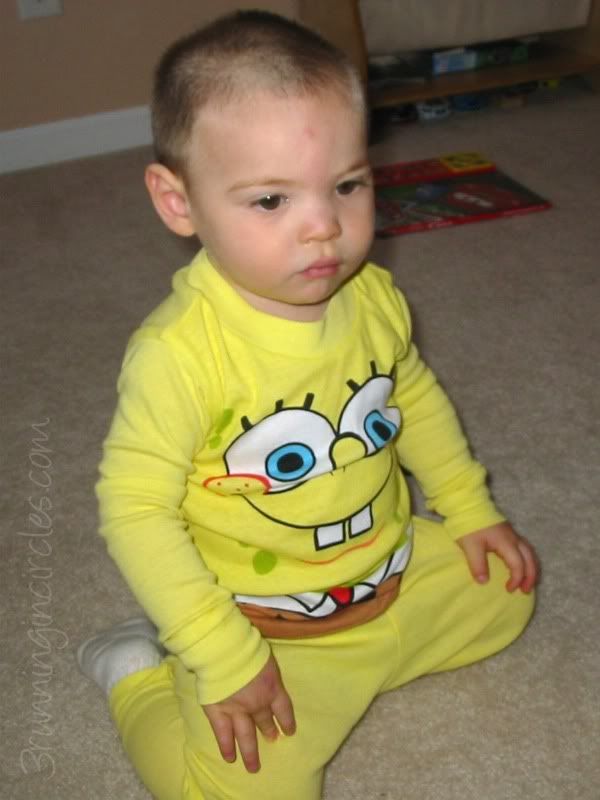
It's hard to pinpoint exactly when or how it happened, but sometime between 15 months and 22 months, Little Bitty slowly regressed. At 15 months, he could say a few words and he learned to point. Pointing was huge from my perspective. It was such a powerful method of communication, one we hadn't experienced with Cuddlebug and Bearhug until they were well into speech therapy at age 3 1/2 to 4. And yet here he was, at 15 months, telling me he wanted a drink by pointing to the fridge, making choices between options presented with this simple use of his finger.
He smiled at everyone, he played peek-a-boo, and he tried to imitate his brothers. He threw these little fits that were sooo mild compared to his brothers' meltdowns - a little angry dance that lasted 1-2 minutes, or when he really meant business he'd get down on the floor and kick a little. He actually looked to see if I was paying attention to his fits and amazingly, he gave up and moved on when he saw that I wasn't. He liked to color and had a natural "tripod" grasp.
We anxiously awaited the "language explosion" that the child development books talk about. Any day now, we were sure he would start saying all kinds of new words. Yep, any... day... now.
Except that he didn't. As he approached 18 months I started to get concerned, but he'd say a word here and there and I'd be reassured, sure that his "language explosion" was just around the corner and that I'd feel silly for worrying once it happened. We noticed that he’d say a new word once or twice and then we wouldn’t hear it again, but we knew that children often experience temporary set-backs in one area of development while they focus on gaining other skills.
At 19 months, I called Early Intervention. He only had about 10-15 words, and that was counting pretty much every word we'd ever heard him say, whether he said it more than once or not. Many of his words didn't really sound like the word they were supposed to be, like "chaw... chay" for "ready... set" (he later added "gah!" to make it ready... set... go!). They took my information and said someone would call me to schedule an evaluation within a couple of weeks. He just happened to say a few words and a 2-word combination ("get cup") right before the EI coordinator called me, so at that point I was feeling reassured and thought he didn't need an evaluation after all.
By the time he turned 2, he still wasn't talking except the occasional random word here and there. We scheduled him for hearing and speech evaluations, convinced that he had a speech delay but still not thinking it was anything more than that.
Shortly after his 2nd birthday, we took a trip home to visit family over spring break. Not long after that, my mom was watching a special on tv about autism. She asked me about some of the signs and said she thought she saw some in Little Bitty. Some were things we'd noticed but hadn't really thought much about. We'd been watching so closely for the autism signs that Bearhug and Cuddlebug had, like the meltdowns, speech delays, and overstimulation, and most of our research had been centered on those areas, so we hadn't really paid attention to other potential signs.
Some signs we hadn't noticed because they were so "normal" to us that they didn't stand out until we really stopped to think about them – obsessing over light switches, not bringing us things to show us, and limited diet (aside from being a picky eater, he strongly preferred liquids to solid foods and would slurp on his food until he could swallow it without chewing). There was also the fact that we already had a pretty autism-friendly environment and routine thanks to his brothers, so some of his needs in those areas were already being met indirectly without us even realizing it.
Looking at a broader list of signs, there was no denying that Bitty had a lot of them. And by that point, the regression was so obvious there was no missing it. I realized I couldn’t remember the last time he’d pointed, or said "Mama." In hindsight I could see that his social and language development had slowed, then stalled, then regressed. The little boy who used to stare down total strangers until they looked at him, just so he could smile at them, now often had a distant, thoughtful expression and seemed oblivious to what was going on around him much of the time. He didn’t respond to his name, didn’t look up or even blink when we talked to him. Even getting down at eye level and tapping him gently on the shoulder wasn’t always enough to get him to notice us. He still liked to be held, but avoided eye contact. He seemed to be drawing more and more into his own world, and we wanted desperately to keep him in ours.

If you enjoyed this post, get free updates by email or RSS.


